Our online finding aid (and access to digitized images) is not functioning properly. As of 30 Sep. 2026, we are working to resolve this ASAP.

Faith and Revolution #7: Moravians and the Announcement of the Declaration of Independence
Posted July 7, 2026 in Digital Access, Faith and Revolution

As readers are likely aware, 2026 marks the semiquincentennial, or 250th anniversary, of the establishment of the United States with the signing of the Declaration of Independence. Lesser known is that some of the earliest announcements of this momentous event were printed by Moravians, making this an excellent opportunity to look at both the initial response of the Moravian Church and at the careers of these Moravian printers.
On July 3, 1776, members of the Moravian Church in Bethlehem gathered for an emergency church council to discuss on the tense circumstances in the American colonies, independence being “fully in the works to be declared,” as the diary of the Single Brethren recounts. When all was said and done, it was determined that Bethlehem residents did not fully understand the situation and resolved they should “refrain from further involvement in the matter with strangers or among ourselves.”
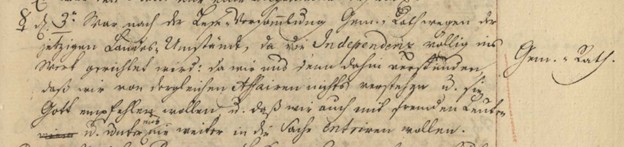
Diary of the Single Brothers in Bethlehem, BethSB 4 (detail), Moravian Archives, Bethlehem
On the following day, July 4, Bethlehem Moravians “learned from the newspapers that Congress had resolved to declare the colonies to be free independent states…”
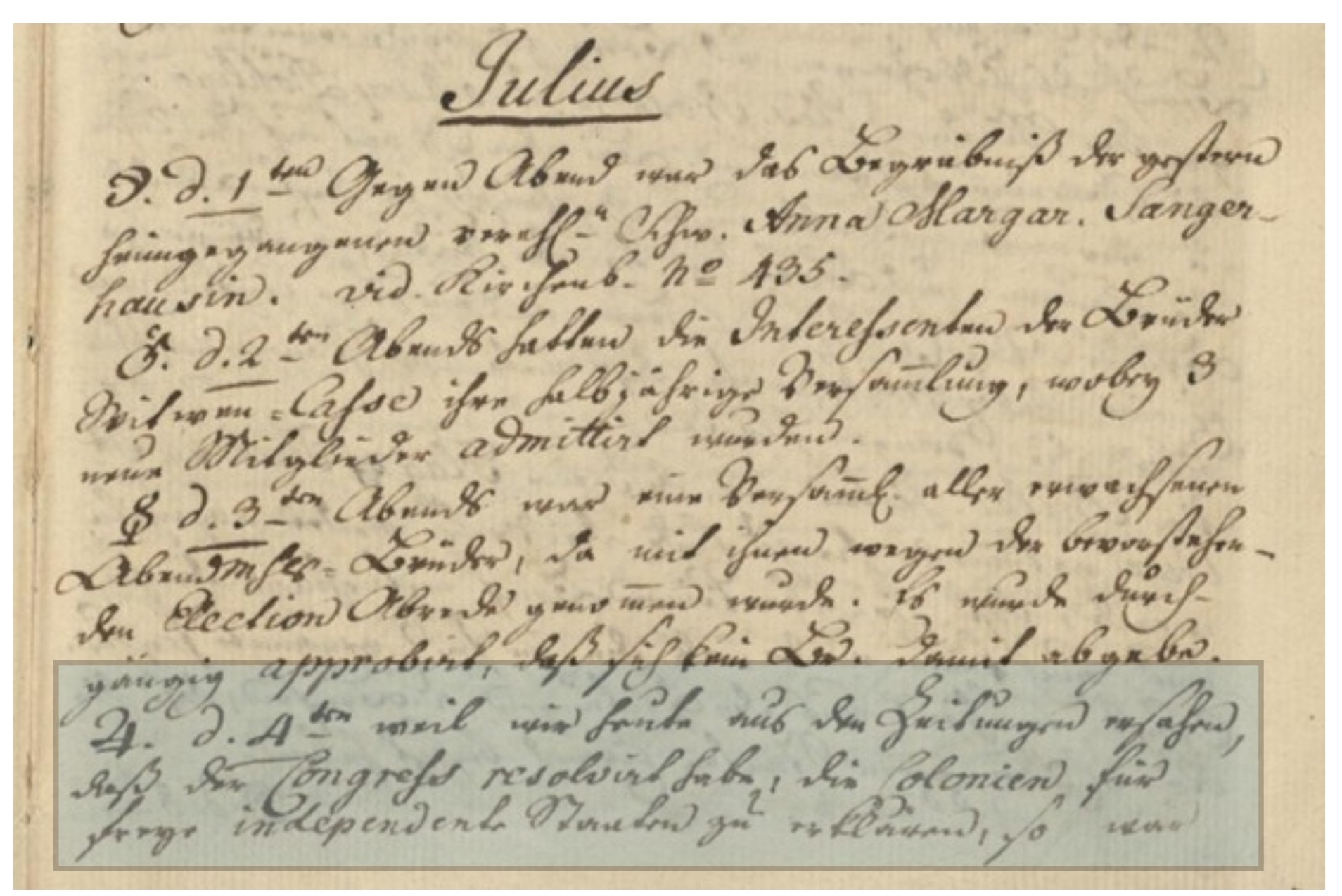
Diary of the Bethlehem congregation, vol. 31, BethCong 31 (detail), Moravian Archives, Bethlehem
While the Moravian congregation in Bethlehem recorded their intention to keep the topic at an arm’s reach not all Moravians shared this desire, and in Philadelphia two Moravian printers would play an integral part in spreading the news of American independence.
As local Moravians predicted, the Declaration of Independence was indeed adopted by Continental Congress and signed by John Hancock on July 4. It wasn’t, however, until the next day, July 5, that its adoption by Congress was announced in a newspaper. Low and behold, the first such newspaper announcement in any language appeared in the Pennsylvanischer Staatsbote, a German-language newspaper published by prominent Philadelphia Moravian and printer Johann Heinrich Müller (also known as Henrich Miller).
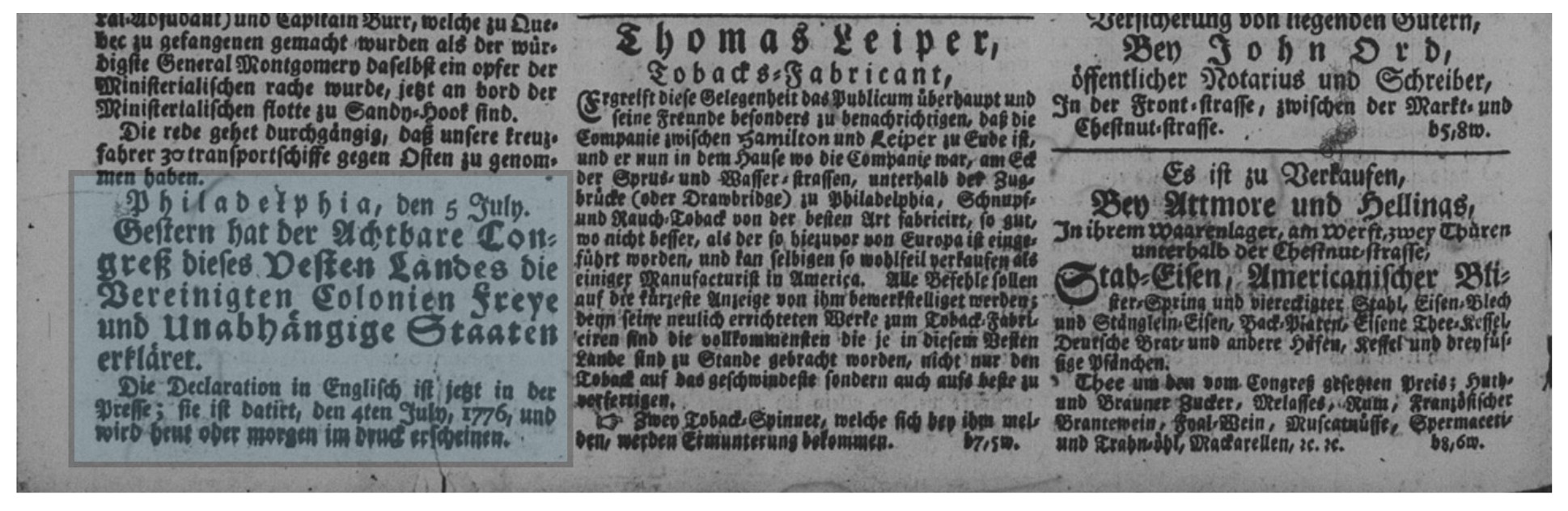
Pennsylvanischer Staatsbote, 5 July 1776, MF 66.2, Moravian Archives, Bethlehem
Original German: Philadelphia, den 5 July. Gestern hat der achtbare Congreß dieses Vesten Landes die Vereinigten Colonien Freye und Unabhängige Staaten erkläret. Die Declaration in Englisch ist jetzt in der Presse; sie ist datirt, den 4ten July, 1776, und wird heut oder morgen im Druck erscheinen.
English translation: Philadelphia, July 5th. Yesterday, the honorable Continental Congress declared the United Colonies to be free and independent states. The Declaration, in English, is now at the press; it is dated July 4th, 1776, and will appear in print today or tomorrow.
The announcement above about the Declaration being “at the press” likely refers to the famed English-language broadside that was produced in haste by Irish American printer John Dunlap. It was Dunlap’s initial broadside that formed the basis for an eventual German translation. Carl Cist, yet another Moravian printer, in partnership with Melchior Steiner, published the first German-language broadside of the Declaration, making it more accessible to roughly one third of Pennsylvania residents at the time who spoke German as a first language.[1] Cist’s translation then appeared in newspaper form on July 9, in Müller’s Pennsylvanischer Staatsbote (see front page of newspaper below), where the signing of the Declaration had been originally announced.
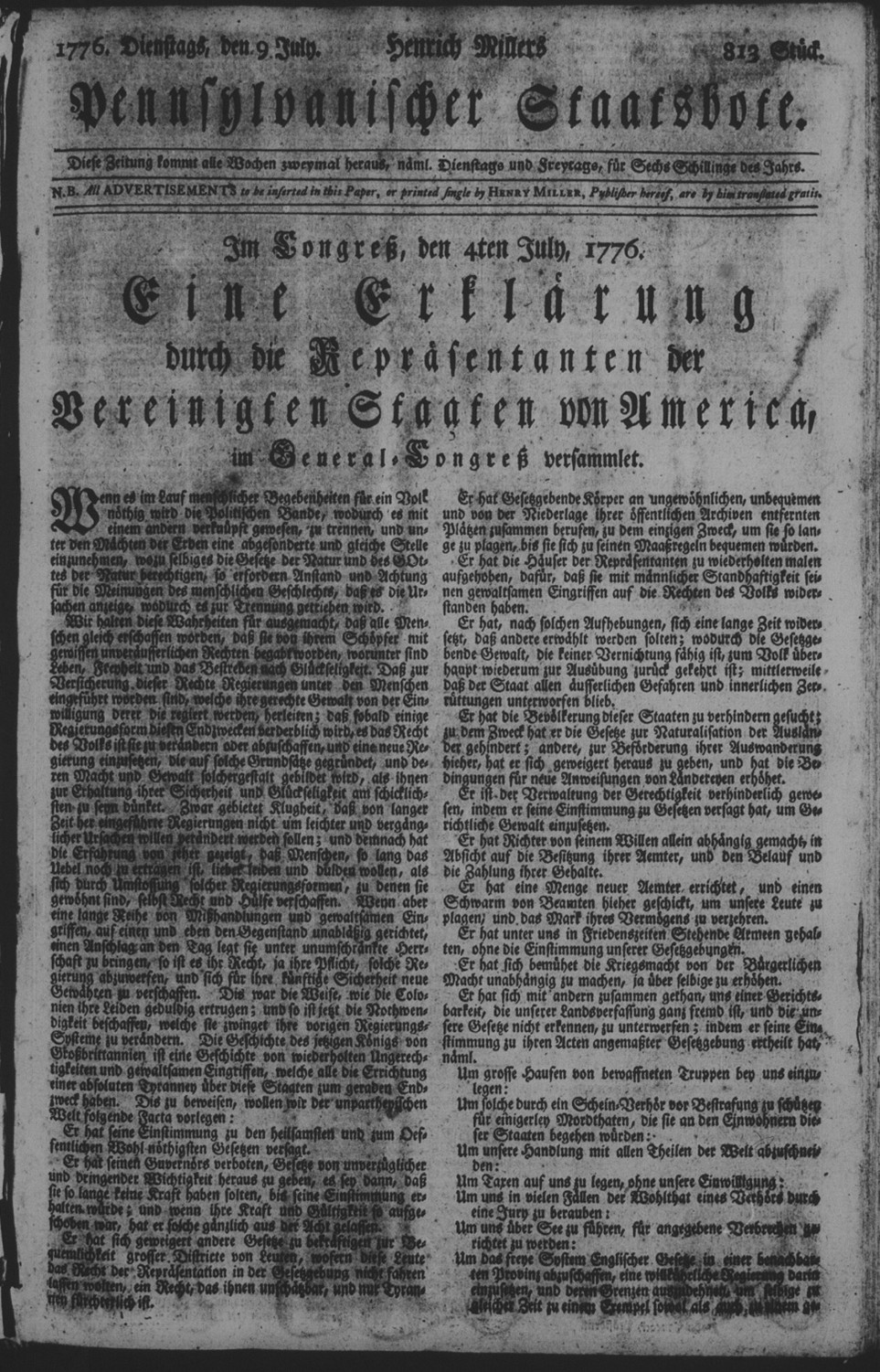
Pennsylvanischer Staatsbote, 9 July 1776, MF 66.2, Moravian Archives, Bethlehem
About Müller, Patrick Erben writes: “Unlike [Benjamin] Franklin, who feared that the influx of German-speaking immigrants would destroy the quintessentially English fabric of life in Pennsylvania and other British colonies in America, Miller recognized and addressed his readers as full members of the commonwealth, whose language and manners were no obstacle to their social and civic participation.”[2]
Further demonstrating Müller’s support for the new nation, Erben writes goes on to write: “In his [1779] farewell address to the readers of the Staatsbote, he encouraged other Germans to be proud of their heritage, while declaring his own allegiance to and even preference for America…As evidence, Miller published a German-language newspaper that was self-consciously American.”
A Vocational Lineage
Before opening his own print shop with Melchior Steiner, Carl Cist had served as a journeyman printer under Müller, who in turn had served as a journeyman printer under Benjamin Franklin. Before then, however, Müller had come to the colonies with Count Nicolaus Ludwig von Zinzendorf. Patrick Erben writes, “With Miller’s passage to America [in 1741] and his newly formed association with Zinzendorf and the Moravians, his transformation from a restless journeyman printer to the independent publisher of the most important German-language newspaper during the American Revolution had begun.”
Moravian leader Count Nicolaus von Zinzendorf, who had come to North America with Müller, wished for Müller, despite the local connections he was making in his trade, to return to Europe and operate a print shop. Müller conceded to return to Europe, and at the Moravian print shop in Marienborn, he printed approximately eighty different titles (Müller’s handwritten list below) for the Moravian Church.
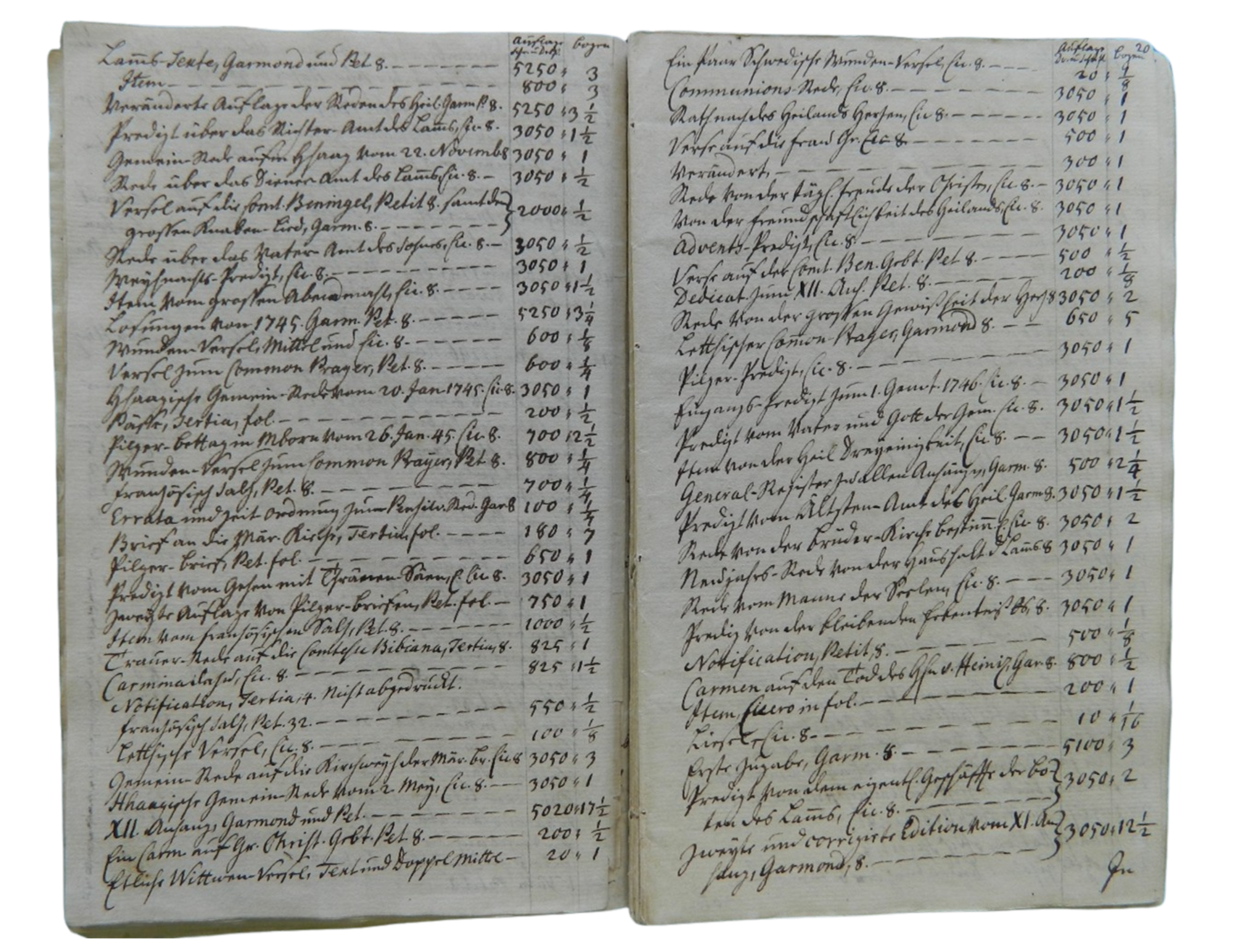
Diary of Johann Heinrich Müller, here featuring a list of his publications in Marienborn, Germany, PP MH 1, Moravian Archives, Bethlehem
After returning to North America for good in the 1750s, Müller continued to print Moravian publications out of his Philadelphia print shop, including annual German-language editions of the Moravian Daily Texts from 1764 to 1776.
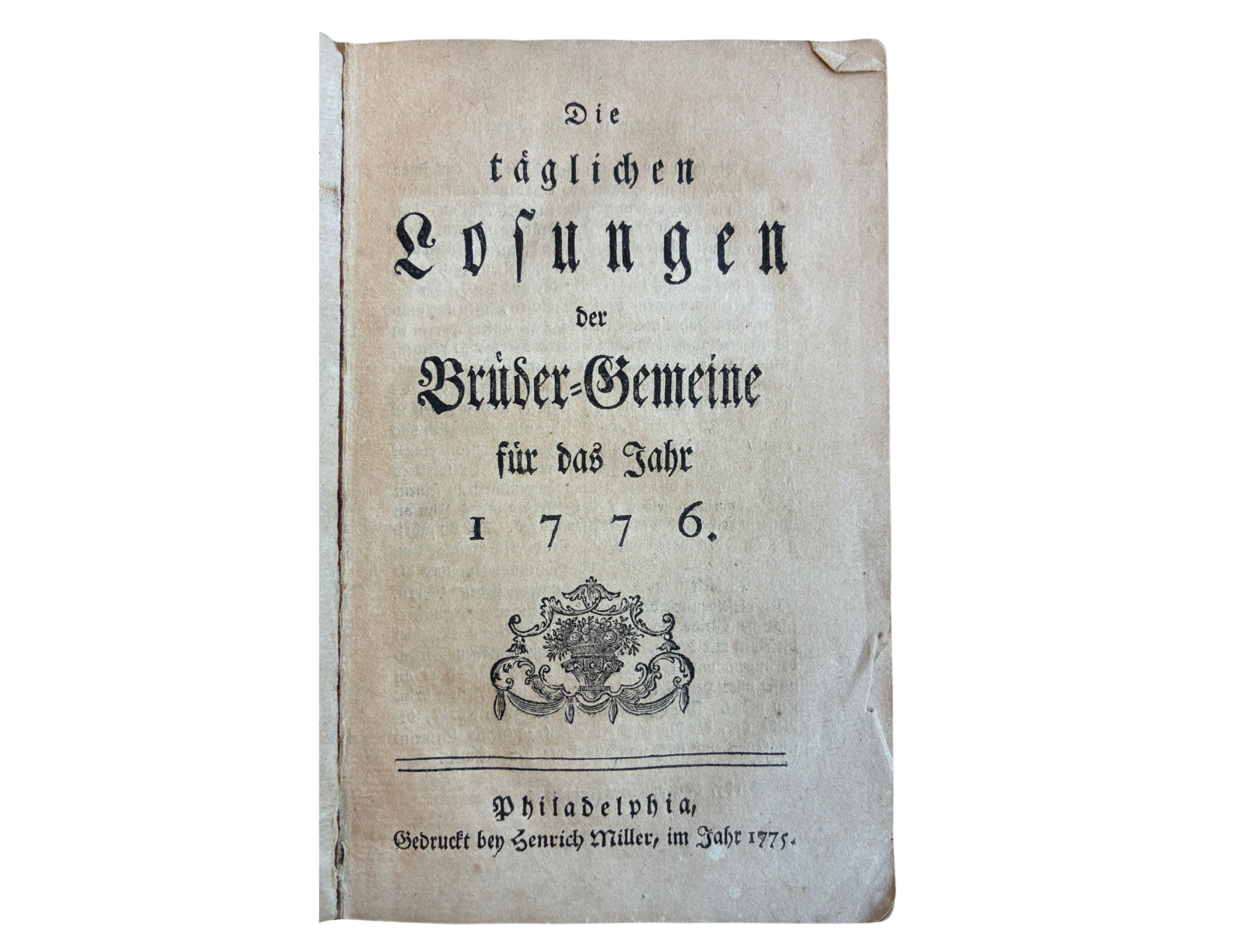
Title page of the Moravian Daily Texts in German, printed by Müller in Philadelphia, DT Ger 1776 A, Library Collection, Moravian Archives, Bethlehem
The Moravian Church’s connection to Müller had benefits that went beyond the church having a printer to produce Moravian texts. A letter preserved in the Moravian Archives reveals that—about a year before the Declaration of Independence was signed—it was Müller, accompanied by Benjamin Franklin,[3] who had visited Continental Congress to deliver a message on behalf of Bethlehem Moravians concerned about pressure from neighbors and the “County Committee” in Easton for Moravians to either participate in military exercises or renounce their allegiance to the British King and Parliament.[4]
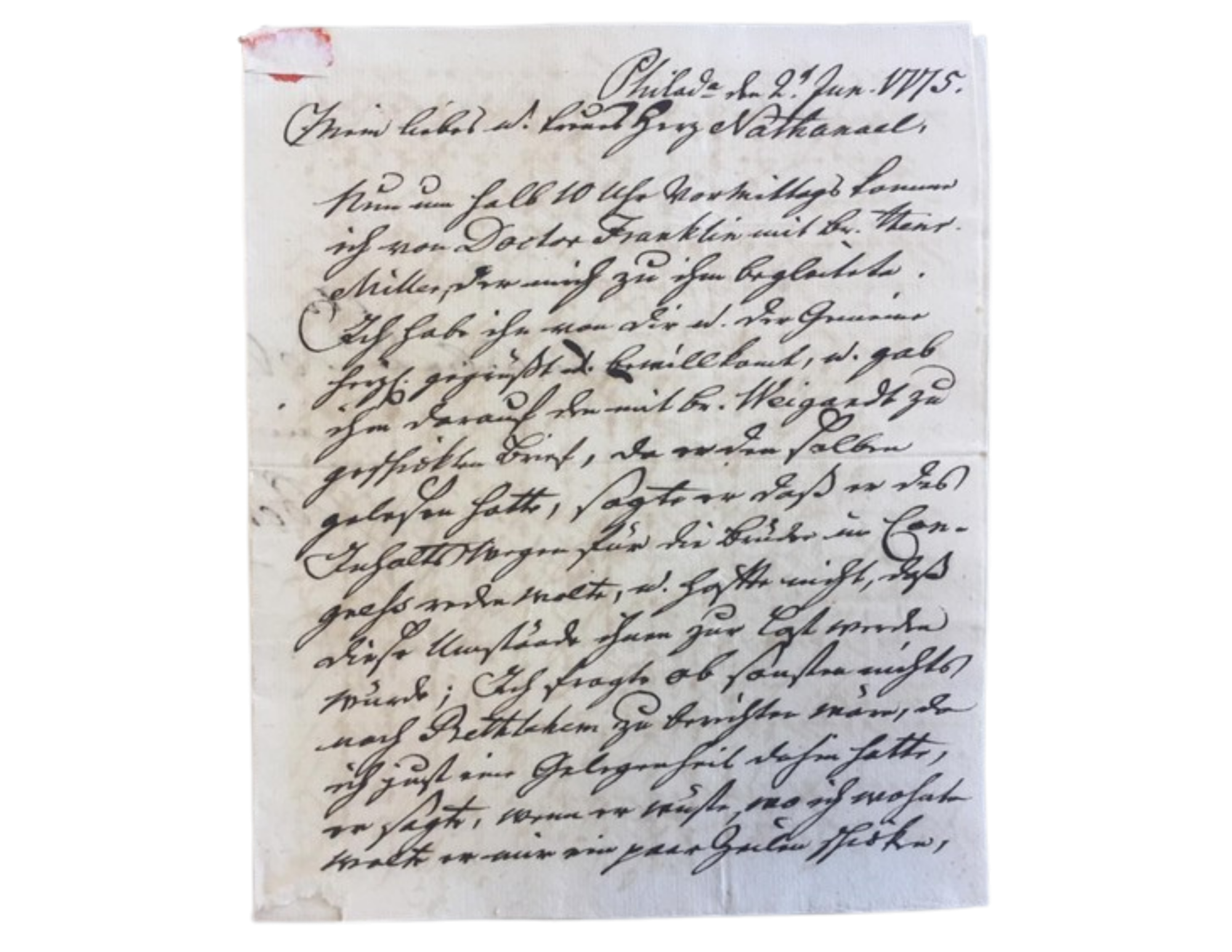
Letter from Jacob Friis in Philadelphia to Nathanael Seidel in Bethlehem, 2 June 1775, PHC 275.8, Moravian Archives, Bethlehem
Both Müller and Cist lived out their final days in Bethlehem and are buried here in the God’s Acre on Market Street. Their careers provide another interesting example of the wide range of responses of members of the Moravian Church in the thirteen colonies to the events they found themselves embroiled in 1776.
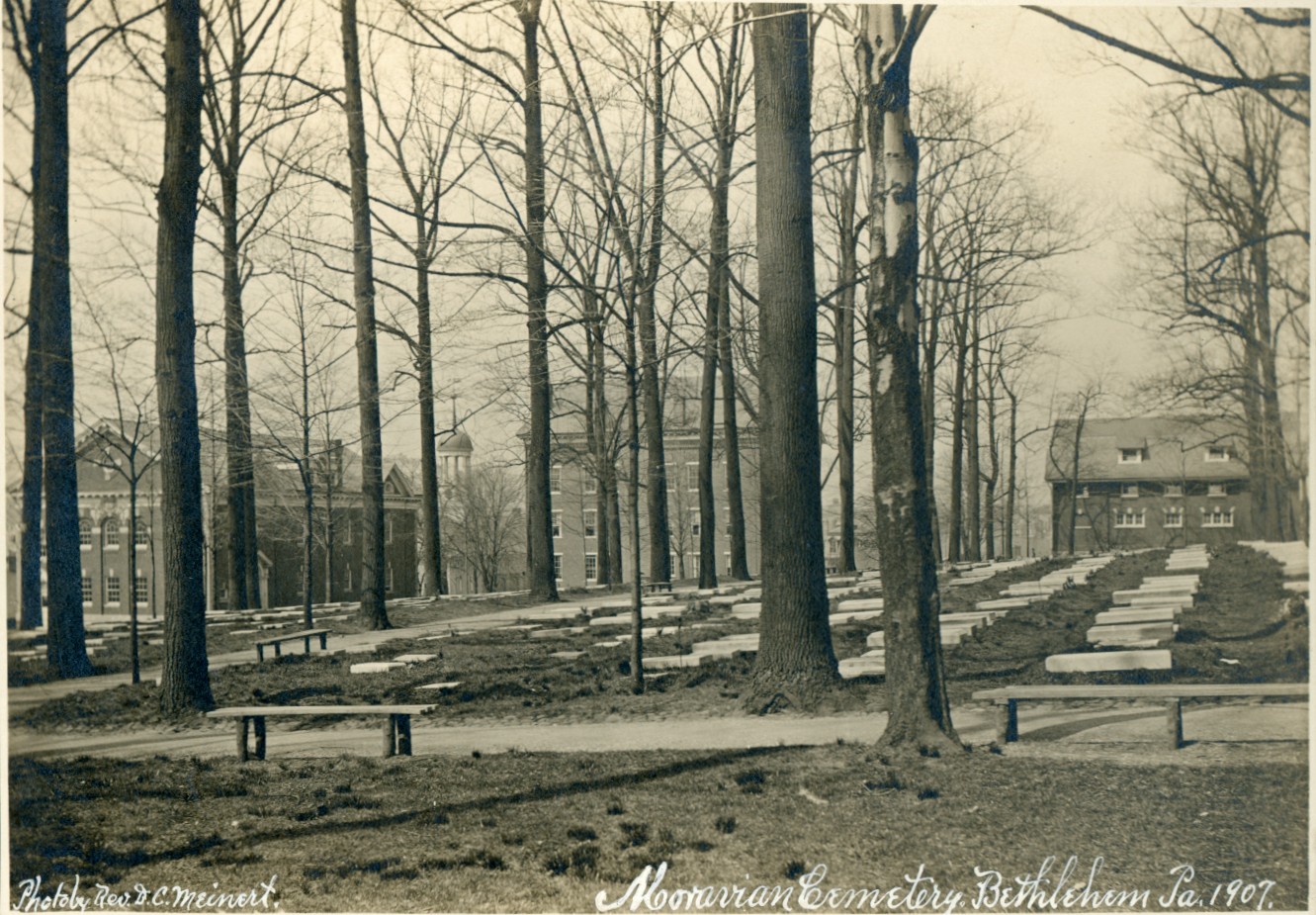
“Moravian Cemetery, Bethlehem, Pa., 1907,” PhotDCM 004, Moravian Archives, Bethlehem
Further Reading:
A transcription of the Declaration of Independence can be read here.
This timeline tracks major points in the writing and spread of the Declaration of Independence.
This article discusses Johann Heinrich Müller’s career and newspaper publishing of the time.
Donald J. Lineback, “Johann Heinrich Muller: Printer, Moravian, Revolutionary,” Transactions of the Moravian Historical Society 23, no. 1 (1977): 61–76. Accessible online here.
Patrick Erben, “Henrich Miller,” Immigrant Entrepreneurship, 8 June 2011; last updated 22 August 2018, https://www.immigrantentrepreneurship.org/entries/henrich-miller/.
Photographs and information about the gravestones of: Johann Heinrich Müller and Carl Cist.
Footnotes:
[1] https://www.declarationstories.org/stories/eine-erklarung
[2] Patrick Erben, “Henrich Miller,” Immigrant Entrepreneurship, 8 June 2011; last updated 22 August 2018, https://www.immigrantentrepreneurship.org/entries/henrich-miller/.
[3] Communications between the Moravians and Benjamin Franklin were also the subject of the first post in this series, available here https://tinyurl.com/bdzd2vrj
[4] 23 May 1775, BethCong 30, Moravian Archives Bethlehem.