
Faith and Revolution #8: A Revolutionary Coincidence: John Henry Antes, the Fair Trade Men, and their Declaration of Independence
Posted August 26, 2026 in Digital Access, Faith and Revolution, General

In earlier posts in this series we have explored how Moravians in well-established communities such as Bethlehem and Lancaster responded to the American Revolution. This month we would like to look at a different topic, that of a former Moravian living on the border of what was then Pennsylvania and their connection to a community who had settled outside the border and are said to have separately declared their independence from Great Britain on July 4th, 1776.
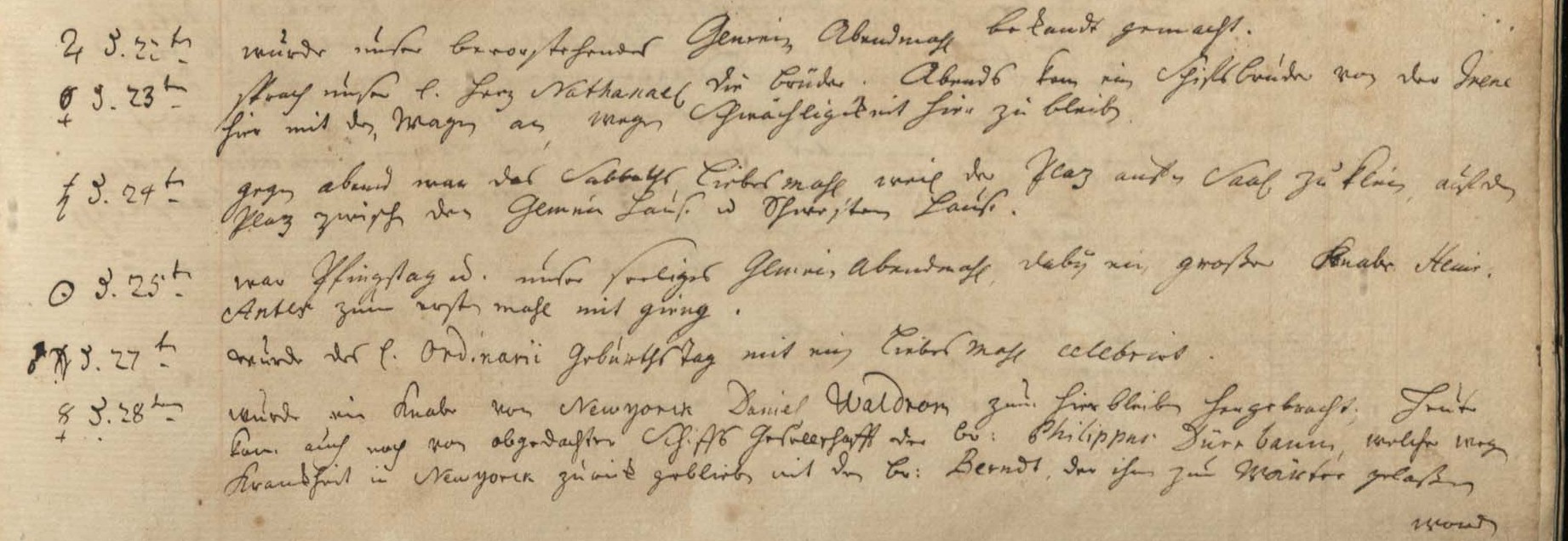
Diary of the Single Brothers in Bethlehem 1742-1762, BethSB 1, Moravian Archives, Bethlehem
Johann Heinrich Antes, or John Henry Antes, was born near present day Pottstown, PA, on October 8, 1736. His father, Henry Antes (1701-1755), was an architect and prominent member of the Moravian Church who is credited as one of the founders of Bethlehem, PA, and designed many of the buildings there. John Henry, the sixth of his eleven children, attended Moravian schools and joined the Bethlehem congregation, as is shown above in the May 25th, 1749, entry in the Bethlehem Single Brothers diary that references his first communion. However, his father left the Moravians the following year on account of a theological dispute, his wife and daughters remained in Bethlehem while his sons accompanied him [1]. While Henry Antes is known to have remained on good terms with the Moravians, as well as with his wife and daughters, John Henry Antes is not known to have had further contact with the Moravian Church. He instead served in the Pennsylvania militia and by the early 1770’s was living along the west branch of the Susquehanna River near present day Jersey Shore, PA. Here he built a home with a stockade, which came to be known as Fort Antes. John Henry Antes also served as Justice of the Peace for Northumberland County, and this life on what was then the western border of Pennsylvania put him in close contact with the community of illegal settlers known as the Fair Play Men.
In the 1770s approximately 100-150 families who came to be known as the Fair Play Men had settled in region of disputed land between the Haudenosaunee and the colony of Pennsylvania [2] and as such were outside the jurisdiction of the colonial government. In response they had set up their own organization, known as the Fair Play System, in which three people were elected as commissioners each March and given unilateral authority to approve or deny new arrivals, solve land disputes, and try criminal cases. As the closest representative of the colonial government, John Henry Antes performed weddings for members of the Fair Play community and they were frequent visitors to Fort Antes to use the mill and stay informed about events in the wider world.
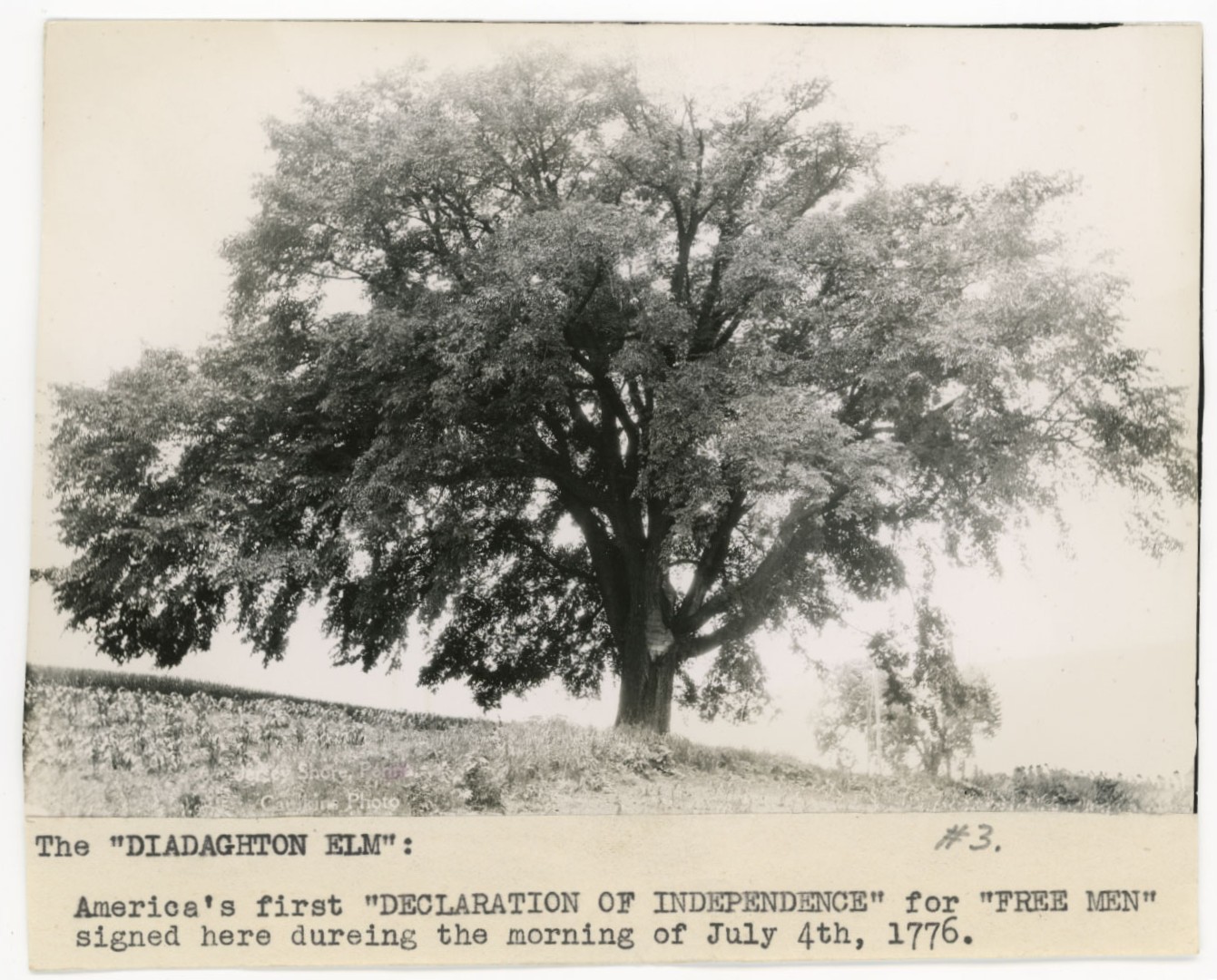
“The ‘Diadaghton Elm”, PhotCollUS PA 1068, Moravian Archives, Bethlehem
It may have been here that the Fair Play men learned of the movement towards independence from the British, leading to the event they are perhaps best known for. On July 4th, 1776, the Fair Play Men are said to have gathered below the tree [3] shown in the photo above and written and signed documents declaring themselves independent from the Great Britain, with a copy taken by messengers to Philadelphia. In some accounts the messengers lost their copy during the trip and regardless upon arrival in the state capital they learned that on the same day as their community the thirteen colonies had formally declared their own independence. As the Revolutionary War broke out, many of the Fair Play Men served in the military, while the region they occupied was amongst the border regions abandoned by settlers in 1778 in light of attacks by Native Americans, possibly allied with the British, an event known as the Big Runaway. In the aftermath of the war, many returned and the Fair Play system is believed to have continued until 1785 when the region formally became part of the Commonwealth of Pennsylvania. John Henry Antes also returned, rebuilt his businesses, and remained in the area until his death on May 5th, 1820.
Unfortunately, research into the Fair Trade Men and their system of governance is greatly complicated by the fact that no written records exist of the organization or the commissioners’ actions, nor has any copy of their declaration of independence survived. The only source for much of the group’s history is firsthand accounts recorded decades later. Historians have suggested that documents may have been lost during the Big Runaway, things may never have been written down as they would be evidence of the Fair Play Men’s illegal settlement, or that some or all of the stories may not be accurate at all. This highlights some of the complexities often found in historical research, the challenge of determining what actually occurred vs. tradition and folklore, especially in the absence of period accounts or physical evidence of an event.
[1] At least one son would eventually return to the Moravians, John Antes (1740-1811), who became a respected missionary, composer, and instrument maker.
[2] While the details are outside the scope of this article the dispute concerned which of two streams in the area marked the border established in the 1763 Treaty of Fort Stanwix.
[3] Usually referred to as the Tiadaghton Elm, the label on the photo is likely a typo, this tree died in the 1970’s though there is still a historical marker at the site.
Further Reading:
These books go into more detail about Henry Antes, John Henry Antes, and the Fair Play Men, and are available in our reading room or online through the Internet Archive:
Edwin McMinn “A German Hero of the Colonial Times of Pennsylvania or the Life and Times of Henry Antes” William J. Lovell, Moorestown, NJ, 1886 –> MAB call number: Cm 64
Edwin McMinn “On the frontier with Colonel Antes” Chew & Sons, printers, Camden, NJ, 1900 –> MAB call number: Eab 175
J. F. Meginness “Otzinachson; or, A History of the West Branch Valley of Susquehanna” Henry B. Ashmead, Philadelphia, 1857 –> MAB call number Ea 81
This article discusses the Fair Play System with a focus on court cases in the surrounding regions that reference them:
Wolf, George D. “THE POLITICS OF FAIR PLAY.” Pennsylvania History: A Journal of Mid-Atlantic Studies 32, no. 1 (1965): 8–24. http://www.jstor.org/stable/27770307.