
Faith and Revolution #10: The First Shots: Moravian Reactions to the Battle of Lexington and Concord
Posted October 23, 2026 in Digital Access, Faith and Revolution

In earlier posts in this series on the Moravians and the American Revolution we have looked at a variety of specific events or individuals using period records such as congregational diaries and letters. This month we would like to do something a little different and instead focus on a category of resource, presenting a selection of entries from official Moravian records such as congregation diaries and reports that reflect the events of the first six months of the Revolutionary War.
While the tensions between the British government and the inhabitants of their Thirteen Colonies in North America that would give rise to the American Revolution and the establishment of the United States of America had existed and festered for decades, the beginning of the Revolutionary War is generally accepted as being the Battles of Lexington and Concord. On April 19th, 1775, a force of British troops was sent from Boston to the nearby town of Concord to seize a cache of weapons stored there by a local militia. Unbeknownst to the British, the local settlers learned of this plan well in advance and had already moved most of the weapons out of Concord and several riders [1] had left Boston the night before to warn the militiamen of the British movements. Consequently when the British soldiers passed through the town of Lexington that morning they were met by militiamen and gunfire quickly broke out. This grew into a series of skirmishes fought throughout the day and throughout the region, culminating with the British troops returning to Charlestown and the militias blocking them in, beginning the Siege of Boston.
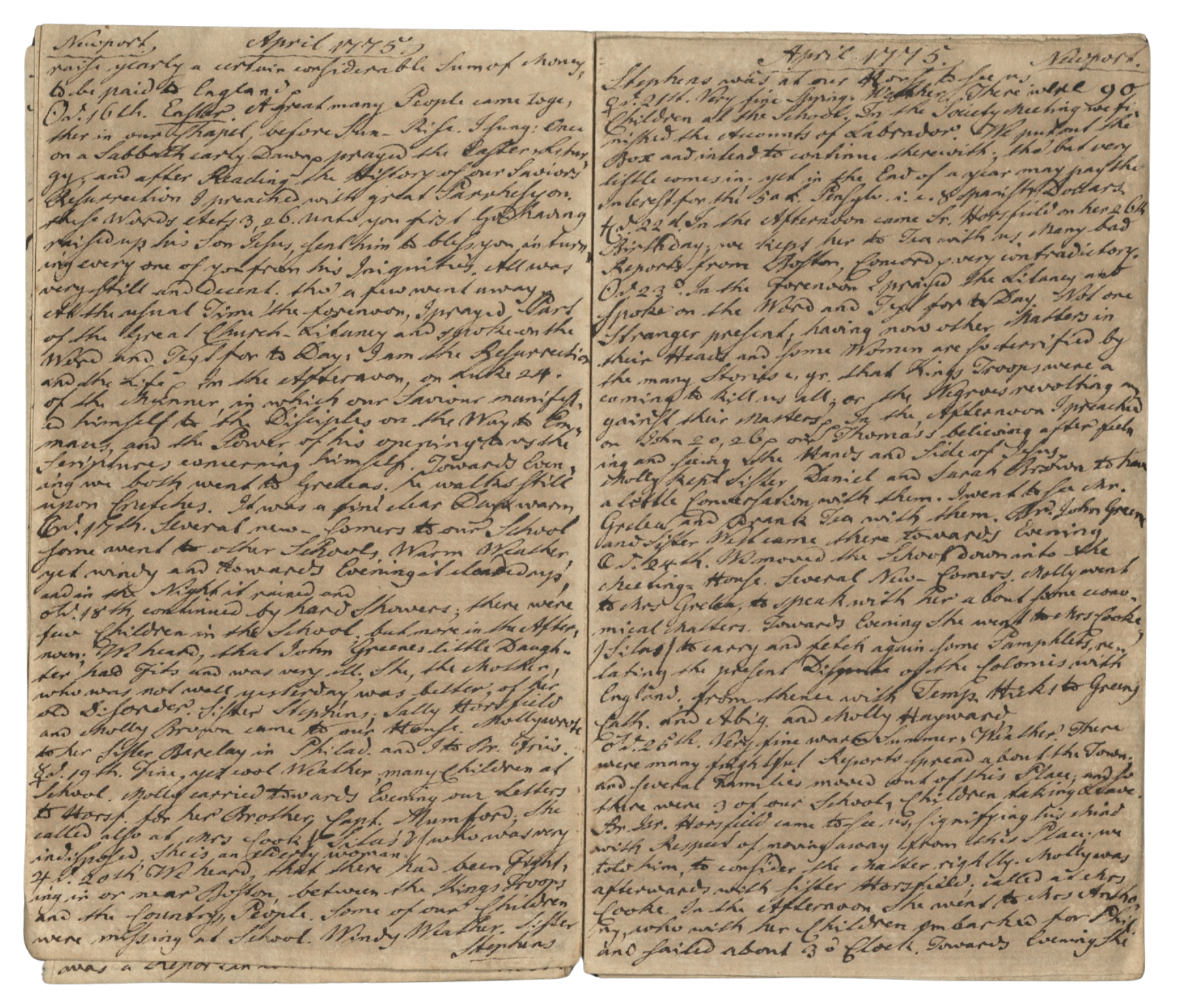
Diary of the Moravian congregation at Newport, Rhode Island, kept by Albrecht Rusmeyer, MC Newport 3, Moravian Archives, Bethlehem
News of these events of course spread swiftly and the first reference we are aware of in a Moravian source is from the following day, April 20th, 1775, when the diary of the congregation in Newport, Rhode Island, reads in part,
“We heard that there has been fighting in or near Boston between the King’s Troops and the Country People”
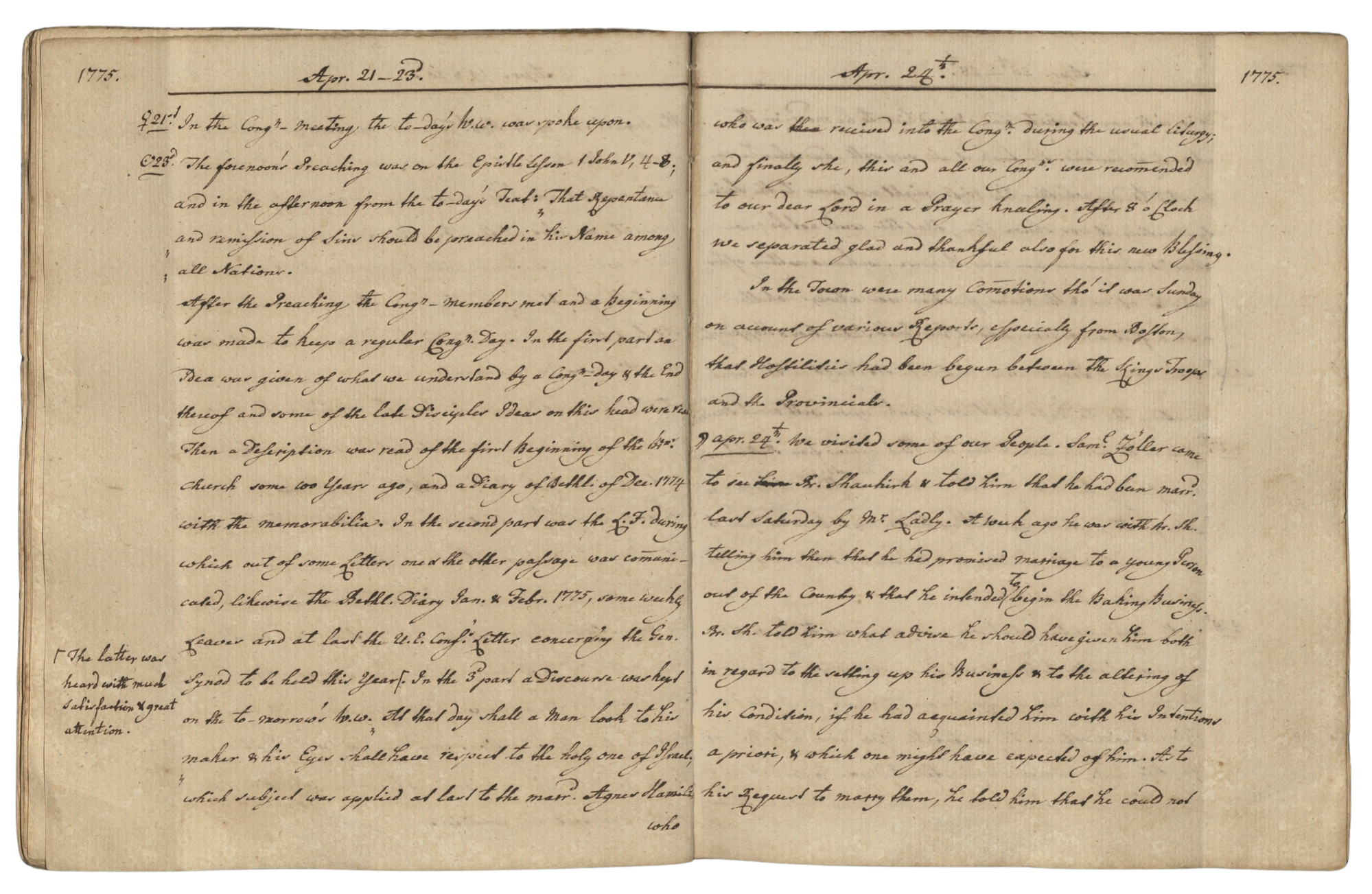
Diary of First Moravian Church of New York, compiled by Gustaf Ewald Shaukirk, MC NY First 15, Moravian Archives, Bethlehem
A few days later it is clear that reports of the battles had reached Manhattan, where in the April 24th entry in the New York First diary it reads,
“In the Town there were many Commotions tho it was Sunday on account of various Reports, especially from Boston, that hostilities had been begun between the King’s Troops and the Provincials”
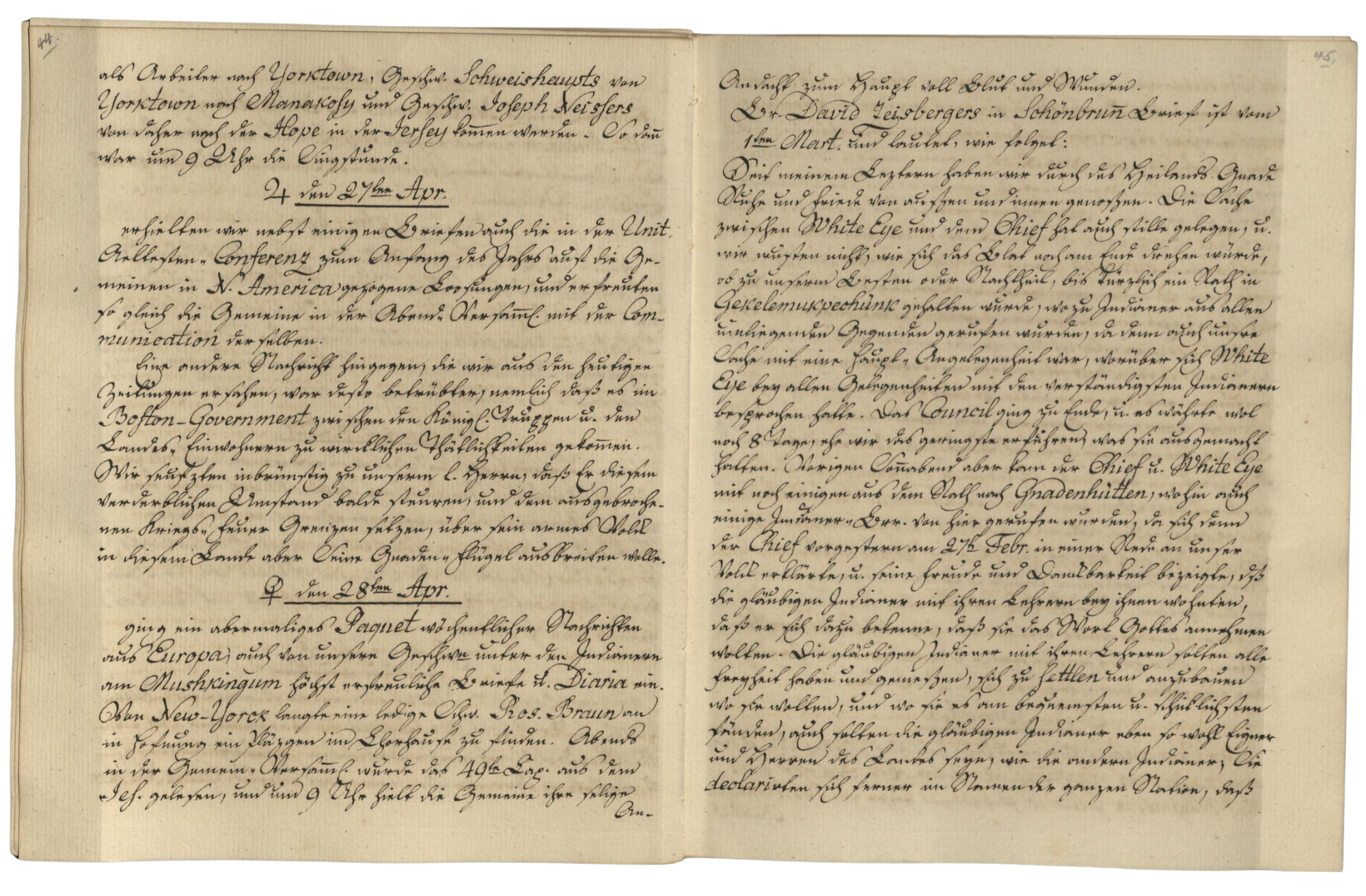
Diary of the Bethlehem congregation, vol. 30, BethCong 30, Moravian Archives, Bethlehem
Within a week the news had reached Bethlehem, Pennsylvania where the diary for April 27th reads in part,
“By contrast, another piece of news we gleaned from today’s newspapers was all the more distressing: namely, that actual acts of violence had broken out in Boston between the Royal troops and the local inhabitants. We sighed fervently to our dear Lord that He would soon put a stop to this pernicious situation, limit the outbreak of war, and spread His wings of mercy over His poor people in this land.”
Unsurprisingly it took considerably longer for news of the outbreak of open fighting to reach the Moravian community on North Carolina and initially it was only rumor, as shown in the entry above from the Salem diary on May 8th,
“Tonight several lawyers lodged in our Tavern. They brought an unpleasant report that in New England there had been a skirmish between the King’s troops and the Militia” [2]
Confirmation would not come for more than a week, when we read in the entry for May 17th,
“This afternoon Br. Richter brought from Bethbara a package of letters, Gemein Nachrichten and newspapers, from Bethlehem and Lititz, which Christian Conrad brought on his return from Pennsylvania. The letters were of April 25th and May 1st, and among other things mentioned the unpleasant fact that about April 19th there had been a skirmish near Boston between the royal troops and the Provincial Militia. The most recent newspaper report that the Congress held in Philadelphia has been declared a Rebellion by Parliament, although Congress vehemently declared its loyalty to the King.”
These accounts, while brief, highlight how the Moravians kept abreast of events in the surrounding world, no doubt wondering how their work and lives would be impacted, and sheds a fascinating light on how gradually news spread in the late 18th century compared with today.
[1] These included Samuel Prescott, William Dawes, and Paul Revere, though the latter has largely overshadowed the others in the popular imagination, likely due to the success of Henry Wadsworth Longfellow’s 1860 poem “Paul Revere’s Ride”
[2] “Records of the Moravians in North Carolina, Volume II 1752-1775”, edited by Adelaide L. Fries, State Department of Archives and History, Raleigh, 1968
Further Reading:
“Battles of Lexington and Concord” National Army Museum
“Lexington and Concord: The Shot Heard ‘Round the World” American Battlefield Trust