
Faith and Revolution #6: Moravian Pacifism in the Aftermath of Revolution: John Ettwein and Alexander Hamilton’s Meeting in Bethlehem
Posted June 23, 2026 in Digital Access, Faith and Revolution

In previous posts in this series we have looked at how the Moravians responded to the American Revolution, including their interactions with notable figures such as George Washington and Benjamin Franklin. This month we would like to look at this topic from a slightly different angle, how Johannes (John) Ettwein, a prominent Moravian leader, spoke about the church’s views on pacifism some years later when meeting with the new nation’s first secretary of the treasury, Alexander Hamilton.
Johannes Ettwein (1721-1802) was born in Freudenstadt, Germany, and joined the Moravian Church at a young age. He went on to become a central figure in the Moravian Church in North America, where he was actively involved with missionary work, helped determine the location of what is now Winston-Salem, North Carolina, and had a leadership position in Bethlehem, Pennsylvania, during the American Revolution. In 1784 he was appointed as a bishop, responsible for all Moravians and church activities in the United States, and it was in this capacity that he met with Treasury Secretary Alexander Hamilton in 1791.
Born on the Caribbean island of Nevis,[1] Alexander Hamilton (1755/1757-1804) advocated for American independence and served in the Continental Army as an artillery officer and aide-de-camp to George Washington. After the war he was involved with preparing the final draft of the Constitution and signed it as a representative for New York. Hamilton went on to have an important career in politics, serving as the first secretary of the treasury during which time he was involved in the creation of the U.S. Revenue Cutter Service,[2] and the nation’s first political party, the Federalists. He was killed in a duel with Aaron Burr, a politician with whom he had repeatedly clashed, on July 11, 1804.
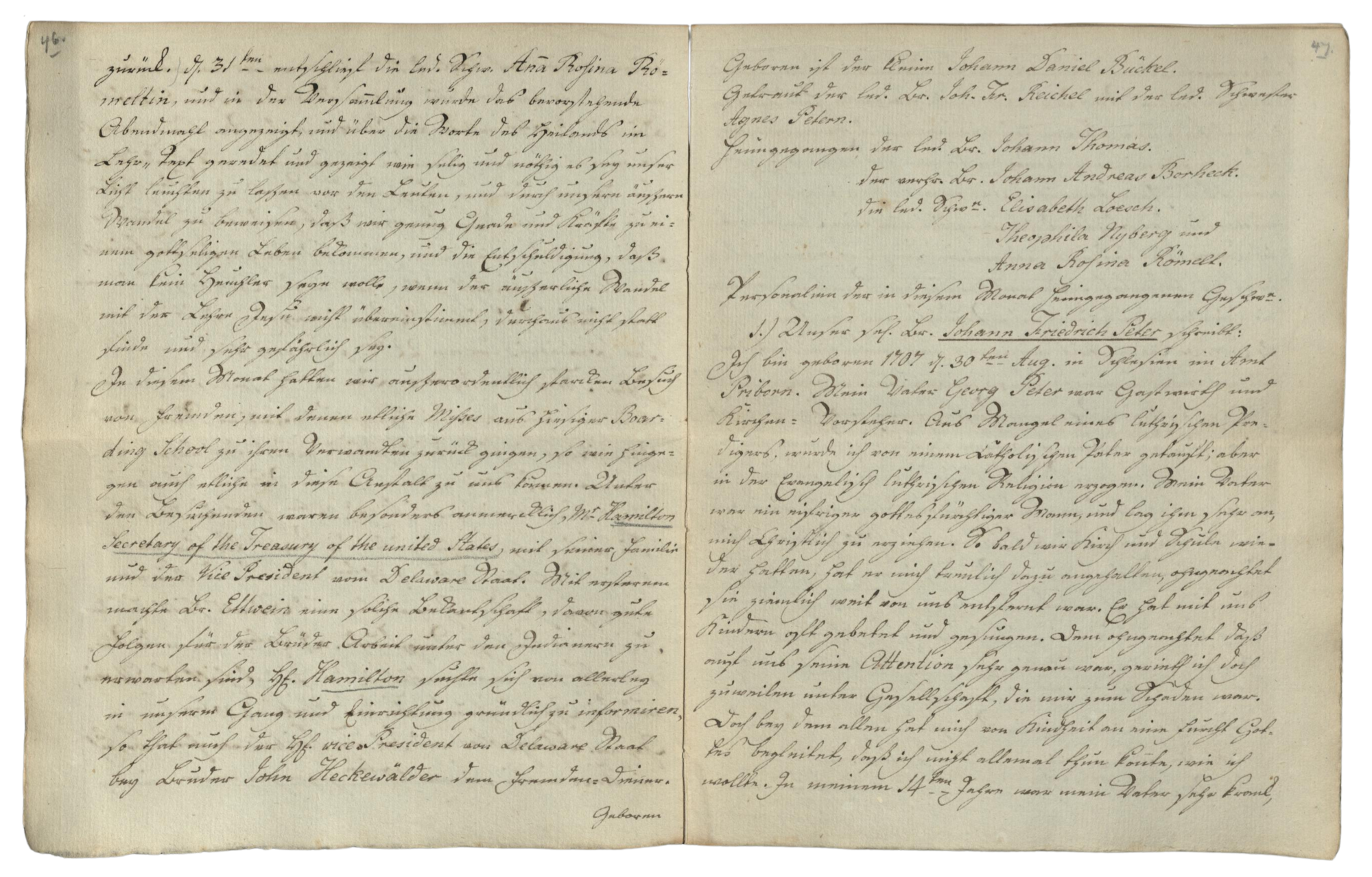
Diary of the Bethlehem Congregation, BethCong 37, Moravian Archives, Bethlehem
In May of 1791 Hamilton left Philadelphia on a trip that included a visit to Bethlehem, Pennsylvania. The reason for this trip is unclear; it does not appear to have been made in an official capacity and may have simply been a vacation. The following excerpt from the Bethlehem diary records his visit and his interest in the Moravians’ activities.
“During this month we had an extraordinarily high number of visits from strangers, with whom a few misses from the boarding school here returned to their relatives; however, quite a few also came to us and into the institution. Of particular note among the visitors was Mr. Hamilton, Secretary of the Treasury of the United States, with his family, and the Vice President of the State of Delaware[3]. With the former Brother Ettwein made such an acquaintance, that it can be expected to bring good consequences for the work of the Moravians among the Indians; Mr. Hamilton sought to inform himself thoroughly about all manner of things regarding our customs and establishment; so did the Lord Vice President from the State of Delaware with Brother John Heckewelder, escort to visiting strangers.”[4]
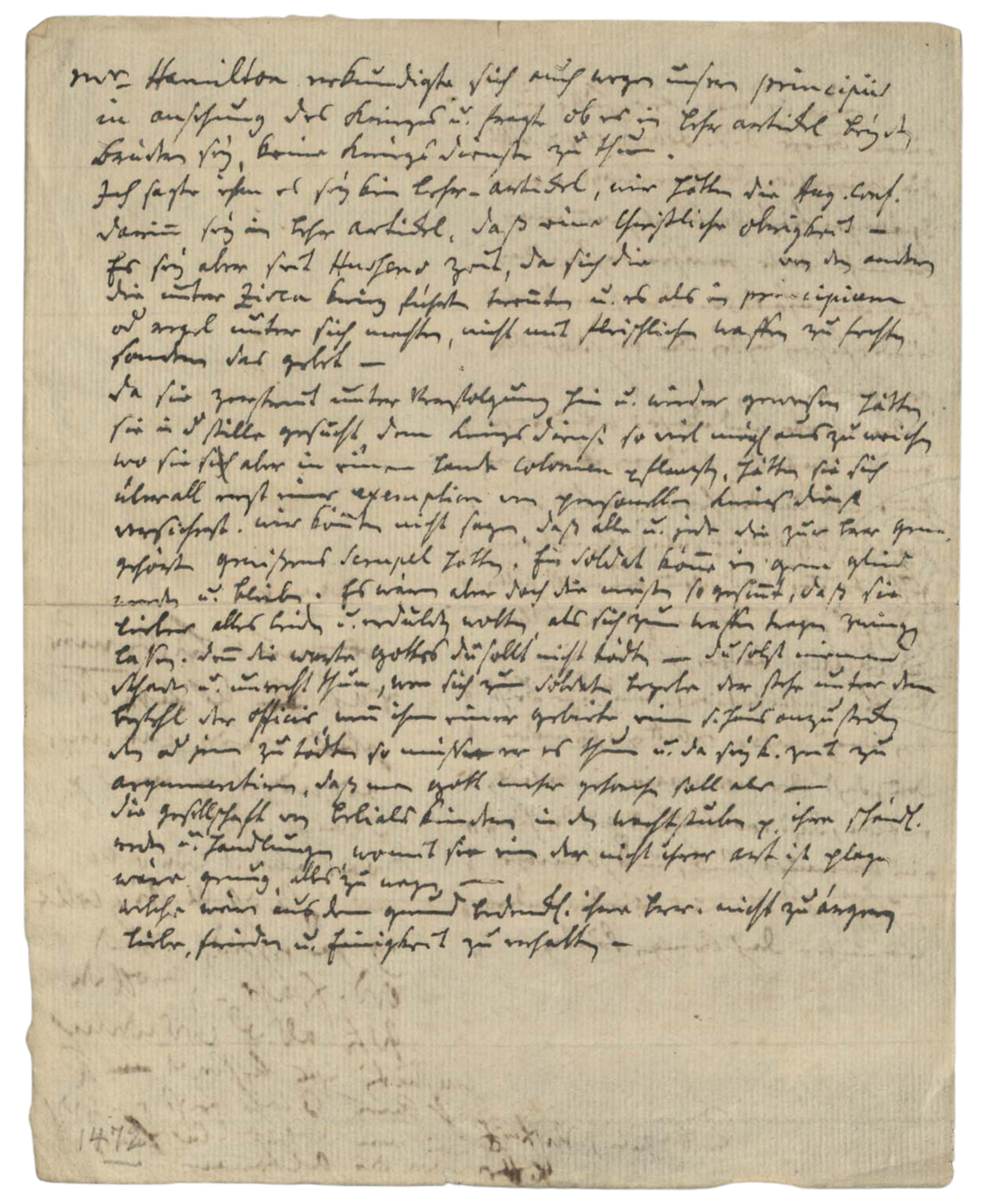
Notes by John Ettwein, documenting his interview with Alexander Hamilton, PP EJ 1472, Moravian Archives Bethlehem
Ettwein would later write the notes shown above, in which he talks about his meeting and discussion with Hamilton. In it he notes that Hamilton enquired about the Moravian’s stance on military service, likely recalling their efforts to remain separate from the war a decade before. The text reads in part:
“Mr. Hamilton asked me about our principles with regard to war and asked whether it was a point of Moravian doctrine to do no military service. I told him it was not a point of doctrine … Ever since Hus’[5] day, the Brethren separated themselves from the others who waged war under Zisca[6] and agreed to make one of their principles or rules not to fight with carnal weapons but with prayer [as argued by Petr Chelčický, one of the Moravian Church founders] … We could not say that each and every member belonging to the Moravian Church had such scruples of conscience. A soldier could become and remain a member.”[7]
Given that during the Revolutionary War Ettwein consistently maintained that the Moravians should have no more involvement in the conflict then was absolutely necessary, it is possible that he was moderating his language while speaking to Hamilton, an influential politician who was himself a veteran of the war and generally supported military actions[8].
These documents not only describe the visit of a significant political figure to the Moravian community in Bethlehem, they demonstrate how the church’s pacifist tendencies and goal of restricting their involvement with the wider world continued to be topics of discussion and concern well after the American Revolution had ended.
Further Reading:
• Johannes Ettwein’s personal papers have been digitized and can be viewed through our online finding aid here
• The Library of Congress has a letter written by Thomas Jefferson to George Washington that mentions Alexander Hamilton’s visit to Bethlehem in passing; A transcription of the letter with annotations can be read here
• This book goes into more detail about Johannes Ettwein’s life and career and includes translations of some of his writings, it is available to study in our reading room or can be read online with a free Internet Archive account: Kenneth Gardiner Hamilton “John Ettwein and the Moravian Church during the Revolutionary Period” Times Publishing Company, Philadelphia, 1940 Johannes Ettwein
[1] Now part of the Federation of Saint Christopher and Nevis
[2] In 1915 Revenue Cutter Service was merged with the Life-Saving Service to form the modern Coast Guard
[3] Prior to the creation of the office of governor, the vice president of the State of Delaware was the Speaker of the Delaware Legislative Council.
[4] “In diesen Monat hatten wir außerordentlich starcken Besuch von Fremden, mit denen etliche Misses aus hiesiger Boarding School zu ihren Verwandten zurück gingen, so wie hingegen auch etlich in diese Anstalt zu uns kamen. Unter den Besuchenden waren besonders anmercklich, Mr. Hamilton Secretary of the Treasury of the United States, mit seiner Familie und der Vice President vom Delaware Staat. Mit ersterem machte Bruder Ettwein eine solche Bekantschaft, davon gute Folgen für der (sic) Brüder Arbeit unter den Indianern zu erwarten sind, Herr Hamilton suchte sich von allerley in unserm Gang und Einrichtung gründlich zu informieren, so that auch der Herr Vice President von Delaware Staat bey Bruder John Heckewälder dem Fremden-Diener.” BethCong 37, p. 46.
[5] Jan Hus (1369-1415), a Czech priest who called for reforms in the Catholic Church, his martyredom led to a series of civil wars known as the Hussite Wars. His calls for reform are often seen as a precursor to the Protestant Reformation
[6] Jan Žižka (1360-1425) a Czech knight and leader of one of the factions during the Hussite Wars
[7] Ich sagte ihm es sey kein Lehr-Artickel, wir hatten die Augsburg Confession darinn sey ein Lehr Artickel, daß eine Christliche Obrigkeit–Es sey aber seit Hussens Zeit, da sich die unter Zisca Krieg fuhrten trennten und es als ein Principium oder Reger unter sich machten, nicht mit fleischlichen Waffen zu fechten sondern das Gebet–da sie zerstreut unter Verfolgung hin und wieder gewesen hätten sie in der Stille gesucht dem Kriegsdienst so viel möglich auszuweichen wo sie aber in einen Lande Colonien pflanzten, hätten sie sich überall erst eine Exemption von personellen Kriegsdienst versichert. Wir könnten nicht sagen, daß alle und jede die zur Brüdergemeine gehörten gewißens Scrupel hatten. Ein Soldat könne ein Gemeinglied werden und bleiben.
[8] In later years Hamilton would advocate for military responses to the Whiskey Rebellion and during conflicts with France